I don't normally lead with "what on earth did I just read" — but here we are. Meta has published research on something called Brain2QWERTY, and it genuinely stopped me mid-scroll.
Here's what they did. They put participants in front of a keyboard and asked them to type. While they typed, a device called an MEG scanner — think a helmet that measures magnetic fields produced by your brain — recorded their neural activity. Then they trained an AI on those recordings to figure out what the brain was trying to say.
No surgery. No implants. Just a person, a keyboard, a helmet, and an AI learning to read the signals in between.
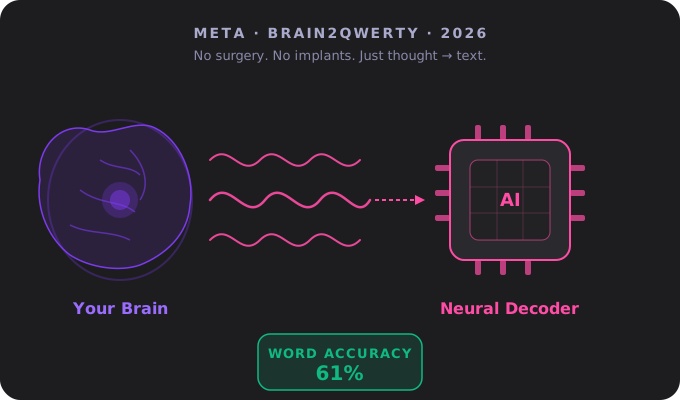
The number that got me
Previous attempts at this kind of non-invasive brain decoding topped out at about 8% word accuracy. Not great. Basically a parlour trick.
That's not a parlour trick. That's a jump that changes what this technology is. And the research shows accuracy improves log-linearly with more training data — meaning this is nowhere near its ceiling.
So what exactly is happening?
The system trained on roughly 22,000 sentences from nine volunteers, each spending about 10 hours in the MEG device while typing. The AI — an end-to-end deep learning model fine-tuned with a large language model — learns to map the pattern of brain signals to the words being typed.
It's not reading your idle thoughts. Not yet. It's reading the neural activity associated with intentional, active communication — the signals your brain fires when you're focused on producing language. But that distinction may not hold for long.
The keyboard might be the last interface humans ever need to learn.
Why it was built — and why it matters beyond the lab
The research is aimed squarely at people who've lost the ability to communicate — through paralysis, brain lesions, motor neurone disease. For them, this isn't a novelty. It's a lifeline. The fact that it doesn't require surgery makes it infinitely more scalable than implant-based systems like Neuralink.
But the implications don't stop there. Think about what this trajectory looks like in five years. In ten. The keyboard replaced the pen. The touchscreen replaced the keyboard. Voice replaced the touchscreen for a lot of tasks. What comes after voice is starting to take shape — and it involves the AI reading the signal before it even reaches your hands.
What this means if you work in technology
Every major shift in how humans interact with computers has required organisations to retrain their people, redesign their processes, and rethink what "using technology" even means. The PC. The internet. The smartphone. AI.
This is the next one on the horizon. It won't be mainstream next year. But it will be mainstream — and the organisations who start thinking now about what human-computer interaction looks like in a brain-first world will be the ones who aren't scrambling to catch up when it arrives.
I'm not saying panic. I'm saying pay attention. The pace of progress in AI right now — where 8% becomes 61% in a single research cycle — is the thing that should be informing how your organisation thinks about technology adoption, change readiness, and the skills your people will need.
We went from "AI can write emails" to "AI can read your brain" faster than most transformation programmes complete their first phase.
That's the headline. Not the technology itself. The speed.