I came across a quote this week that stopped me mid-scroll: "I don't prompt Claude anymore. I write loops — and the loops do the work." That one sentence changed how I think about where AI is heading.
Most of us are still in prompt mode. We type something in, we get something out, we tweak and try again. It works. But it keeps us in the loop in a way that limits what's possible. Every output still needs us to push it forward. We're the engine.
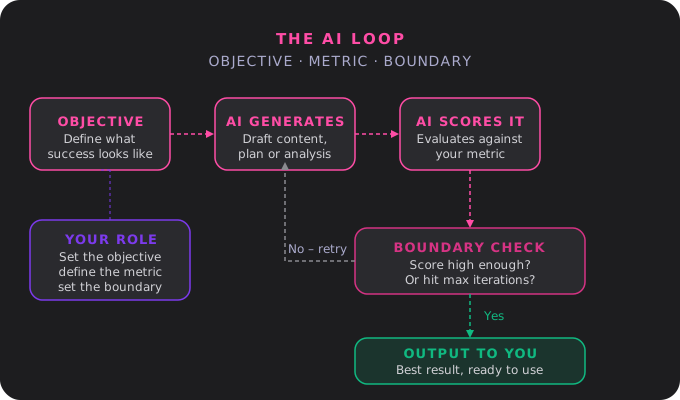
Loops flip that. You set the system up once, and it runs. The AI generates. The AI evaluates. The AI iterates. You come back to the best result.
What an AI loop actually is
It's simpler than it sounds. An AI loop has three parts:
Within those three constraints, the AI generates a draft, scores it, critiques what's not working, rewrites, scores again — and keeps going until the score is high enough or the boundary is hit. Then it surfaces the best version.
You're not in the middle of that process. You designed the process.
Why this matters for change work
Think about the tasks that eat your week. Drafting comms for multiple stakeholder groups. Summarising interview findings. Pulling together a readiness report. Creating training session descriptions for different teams.
These are all tasks where you know what good looks like — you just spend hours getting there. A loop lets you define "good" once and have the AI work toward it without you hovering over every draft.
You're not writing a prompt. You're designing a process that runs without you.
That's a different skill. And it's a more valuable one. Anyone can write a prompt. Fewer people can define an objective clearly enough, a metric precisely enough, and a boundary wisely enough for a system to run on its own and produce something worth using.
Two kinds of loops
There are running loops and learning loops, and the difference is worth understanding.
Running loops do the same task consistently every time. Set them up once and they deliver. A weekly summary. A project status update in a specific format. A comms template populated from a brief.
Learning loops improve over time. They incorporate your feedback — a thumbs up or down, a correction, a preference — and the next output is better than the last. The system gets smarter as you use it.
Most of us are still doing running loops manually. Typing the same prompt every Monday. Reformatting the same report. Rewriting the same email for a different audience. A loop automates that. A learning loop makes it better each time.
What your job becomes
Here's the shift that I find most interesting. In a loop-based way of working, your job isn't generating content anymore. It's making three decisions:
- What does success look like? (Objective)
- How do we measure it? (Metric)
- How far do we let it run before we review? (Boundary)
Those decisions require judgement, values, and context. They require knowing your stakeholders, understanding risk, and having a point of view on what "good" actually means for this situation. That's not something AI can replace. That's the expertise you've built over your career.
The people who will do this work best aren't the ones who type the fastest or craft the cleverest prompts. They're the ones who can think clearly about what success looks like and articulate it precisely enough for a system to work toward it.
Change managers already do this. We define outcomes. We design processes. We set boundaries on what needs human sign-off. We've been doing the conceptual work that AI loops are built on — we just haven't been applying it to AI yet.
Where to start
Pick one repetitive task. One where you already know what a good output looks like. Write the objective in one sentence. Define a simple metric — even a 1–10 score with two criteria is enough. Set a boundary of five iterations.
Then ask Claude to run the loop for you.
You don't need to code anything. You don't need a developer. You need to be clear about what you want — which, if you've spent any time in change management, is something you've been practising your whole career.
Building fluency like this is the training gap, one of five that decide whether an AI rollout lands. You can read the full set in the five gaps that decide AI rollouts.