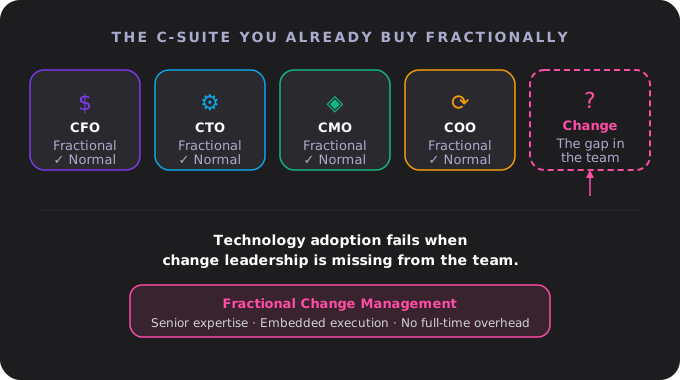
If you're a CIO at a mid-market company, you've probably hired a fractional CFO. Maybe a fractional CTO or CMO too. You understand the model. Senior expertise, embedded in your team, without the full-time overhead. You don't question it anymore — it's just how smart organisations fill capability gaps.
So here's a question worth sitting with: why is the change seat still empty?
Not the project manager seat. Not the business analyst seat. The seat that belongs to someone whose job is to make sure the people in your organisation actually adopt the technology you're spending millions to implement.
The fractional model is already normal — except for change
Fractional executives are now mainstream. CFOs for finance oversight. CTOs for technology strategy. CMOs for marketing leadership. Companies in growth phases, mid-transformation, or navigating complexity hire these roles fractionally because they need senior expertise at specific moments — not a full-time salary every week of the year.
The logic is straightforward: you need a CFO, but your finance function doesn't require 40 hours of executive oversight a week. So you buy what you need, when you need it. The fractional model has proven itself at every level of the C-suite.
But ask yourself who's leading change on your technology projects. In most organisations, it's the project manager wearing an extra hat. Or a training coordinator. Or nobody with a clear mandate at all. The function that determines whether people use the system — whether the business actually gets the return on its investment — is the one that gets left out.
What a fractional change manager actually does
This is where it's worth being precise, because "change management" gets misunderstood. It's not training. It's not communications. It's not the stakeholder newsletter that goes out before go-live.
A fractional change manager is embedded in your programme. They assess the change impact on each team. They identify the people who will make or break adoption. They work with your business leads to design the support, the comms, and the readiness activities that actually move the needle. And then they execute — not from the outside looking in, but from inside the project, alongside your team.
The difference from a consultant who delivers a report and disappears is significant. This model is about continuity and execution. They know your organisation, your politics, your history. They build trust with your people over time.
You're not paying for a document. You're paying for someone who stays until it sticks.
The cost argument is simple
A senior full-time change manager in Australia will cost you $180K–$220K+ in salary and on-costs — before you factor in that you may only need that level of intensity for 12–18 months. A day-rate contractor on a large programme runs $1,200–$1,800 per day, and you lose them the moment the project ends.
A fractional arrangement gives you structured, ongoing access to senior change leadership — scoped to what your programme actually needs, scaled up during intensive phases and back down when it's quieter. No seat to fill when the project wraps up.
The real question isn't cost. It's risk.
The Standish Group has tracked IT project outcomes for decades. The numbers are consistent and uncomfortable: a majority of technology projects don't deliver their intended benefits. The most common reason isn't technical failure. It's people not adopting the system, not changing their behaviour, not understanding what's expected of them.
That's a change problem. And it's one that no amount of feature development, testing, or technical documentation fixes.
CIOs who've been through a difficult go-live know this. You can build the perfect system and still have a failed project if the organisation wasn't brought along. The fractional change model is the insurance against that outcome — bought at a fraction of the cost of the project risk it mitigates.
Completing the team
Here's how I'd frame it for any CIO considering their next transformation: you wouldn't run a finance-heavy project without a CFO perspective embedded. You wouldn't run a technically complex build without a senior technologist in the room. Don't run a technology adoption project without someone who's done this before — who knows where the resistance will come from, who can read the organisation, and who stays until the job is done.
The fractional model already exists for every role on your executive team. Change is the last gap to fill.
If you are weighing up how big that gap is on your own project, where the people risk sits before go-live gives you a read on it first.
Frequently asked questions
What is a fractional change manager?
A fractional change manager is a senior change professional embedded in your programme part-time, on a structured ongoing basis. They assess the change impact on each team, identify the people who will make or break adoption, and work with your business leads to design and run the support, communications and readiness activities. They stay inside the project until the change sticks.
How much does a full-time change manager cost in Australia?
A senior full-time change manager in Australia costs $180K to $220K+ in salary and on-costs. A day-rate contractor on a large programme runs $1,200 to $1,800 per day, and you lose them when the project ends. A fractional arrangement is scoped to what your programme needs and scales up and down with it.
Why use a fractional change manager instead of hiring one?
You get senior expertise without carrying a full-time seat you may only need at high intensity for 12 to 18 months. A fractional change manager can typically deploy in 1 to 2 weeks, compared with 3 to 6 months to hire a permanent role. There is also no redundancy cost when the project ends or scope changes.
Is change management the same as training and communications?
No. Training and communications are part of it, but a change manager also assesses the impact on each team and identifies who will make or break adoption. They then design the support and readiness activities that actually move the needle. Change management is about people using the system, not just hearing about it.
Why do technology projects fail to deliver their benefits?
A majority of technology projects do not deliver their intended benefits, according to the Standish Group's tracking of IT project outcomes, and the most common reason is not technical failure. It is people not adopting the system, not changing their behaviour and not understanding what is expected of them. That is a change problem, and no amount of feature development or testing fixes it.