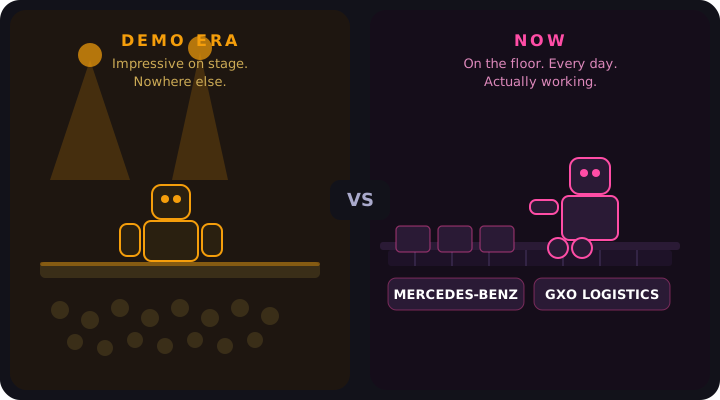
For years, humanoid robots have been the technology that's always five years away. Impressive on a stage. Viral on social media. And then — nothing. Back in the lab. Back to the demo reel.
That just changed.
Apptronik, an Austin-based robotics company, just announced the expansion of what they're calling Robot Park — a 90,000 square foot facility where their humanoid robot, Apollo, trains for real-world deployment. And when I say real-world, I mean it. Apollo is already deployed at Mercedes-Benz. At GXO Logistics. Working shifts. Moving things. Doing the job.
"The industry has spent years showing what robots can do in demos. We're focused on what they can do every day on the job."
— Jeff Cardenas, CEO, Apptronik
That quote landed hard. Because it's true — and it signals something important. The era of robotics as spectacle is ending. The era of robotics as infrastructure is starting.
What Apollo actually is
Apollo is a modular, AI-powered humanoid robot. It comes in two configurations — a wheeled base for industrial environments and a bipedal version for more complex, unstructured spaces. It's designed to work alongside humans, not replace entire facilities. It does the physically demanding, repetitive work while humans do everything that requires judgement, relationship, and context.
At least for now.
Apptronik has partnered with Google DeepMind to develop the AI models that power Apollo — the same Google DeepMind building Gemini. The data Apollo collects in the field feeds directly back into training better models, which make the next version of Apollo smarter. It's a loop, and it's already running.
Why this moment matters
We've been told robots were coming to the workplace for decades. What's different now is that they're not coming — they're here. Not everywhere. Not doing everything. But deployed at scale, at real companies, doing real work.
The gap between "lab demonstration" and "commercial deployment" is one of the hardest gaps in technology to cross. Apptronik has crossed it. Mercedes-Benz wouldn't put something on their production floor that didn't work. GXO Logistics wouldn't integrate something into their supply chain for the novelty of it.
This is the quiet moment before something becomes normal. Like the first iPhone. Like the first time you used Google Maps instead of printing directions. It feels new and slightly unreal — and then, very quickly, it just becomes how things work.
The question worth asking
Not "will this affect jobs?" — that conversation is already ten years old and largely unresolved. The more useful question right now is: what does your organisation know about how to integrate physical AI into a human workforce?
Because that's the next frontier of technology adoption. Not software. Not apps. Robots. On the floor. Working next to your people.
The organisations thinking about that now — the culture, the change management, the practical questions of how humans and humanoid robots share a workspace — will be the ones who get it right when it lands at scale. And based on what Apptronik just announced, that's not as far away as you might think.