Apptronik just announced Robot Park — a 90,000 square foot facility in Austin where their humanoid robot, Apollo, trains for real-world deployment. I've read the announcement three times. Here are the three things I haven't been able to shake.
They built a school. For robots.
Robot Park isn't a factory. It's not a showroom. It's a training facility — a place where robots go to learn how to do jobs before they go and do those jobs.
Think about that framing for a second. We build schools because humans need to practise before they're ready to work. We create onboarding programmes for the same reason. We have probation periods, buddy systems, graduate programmes. All of it exists because learning on the job alone isn't enough — you need a structured environment where it's safe to get things wrong.
Apptronik has built exactly that. For robots. Complete with different environment simulations — logistics, manufacturing, retail. The robot practises the task in the training environment, and then deploys to the real one.
I'm not sure why I find this so striking. Maybe because it reveals just how close the parallel between human workforce development and robot workforce development actually is. Or maybe because it tells you something about how seriously the robotics industry is now taking the question of readiness.
There's a loop running that doesn't need us.
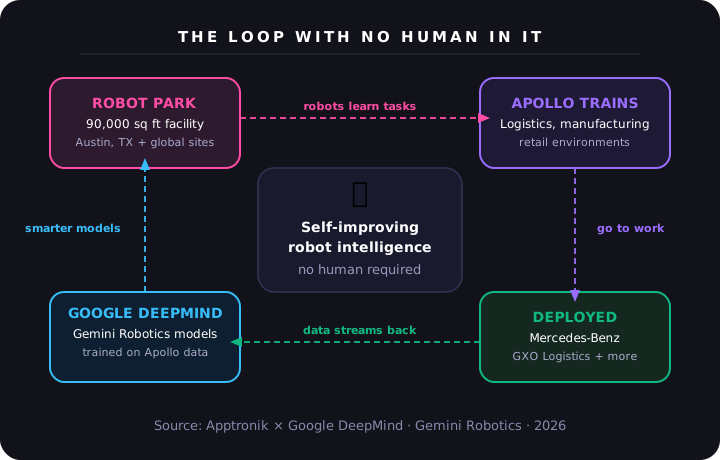
Apptronik is partnered with Google DeepMind to build the AI models that power Apollo. Here's the part that got me: the data Apollo collects while working — in the field, at real companies, doing real tasks — feeds directly back into training those models. Better models make the next Apollo smarter. A smarter Apollo collects better data. And so it goes.
This is a self-improving system. The robots at Mercedes-Benz aren't just doing a job — they're generating the training data that makes the next generation of robots better at doing that job. Without anyone needing to sit down and label a dataset or run a training run.
The loop has no human step in it. It just runs. And gets better.
I'm not saying this to be alarming — I'm saying it because it's genuinely new. Most AI systems improve when engineers improve them. This one improves when it works. That's a different kind of thing.
90,000 square feet is not a pilot.
When companies are testing something, they run a pilot. A few units. One site. Controlled conditions. When a company builds a 90,000 square foot dedicated training facility and announces a global network of similar sites, they're not testing anything.
They've made a bet. A large, expensive, very public bet that humanoid robots at work is not a hypothetical — it's a market. And they're building the infrastructure to capture it at scale before anyone else does.
90,000 square feet is roughly the size of a large supermarket. Imagine that space filled entirely with robots learning to do work. That's not a research project. That's a production line for a new kind of workforce.
The organisations who will get this right aren't the ones who wait until robots show up at their door. They're the ones already asking what it means.
I don't have a tidy conclusion here — I genuinely think we're in a moment where the honest answer is "nobody knows exactly how this plays out." But I do know that the companies and leaders who are paying attention now, who are already thinking about what human-robot collaboration looks like in practice, will have an enormous advantage over those who treat this as a future problem.
Robot Park opened this week. That's not a future problem anymore.